The Rise of the Full Stack Product Manager (FSPM)
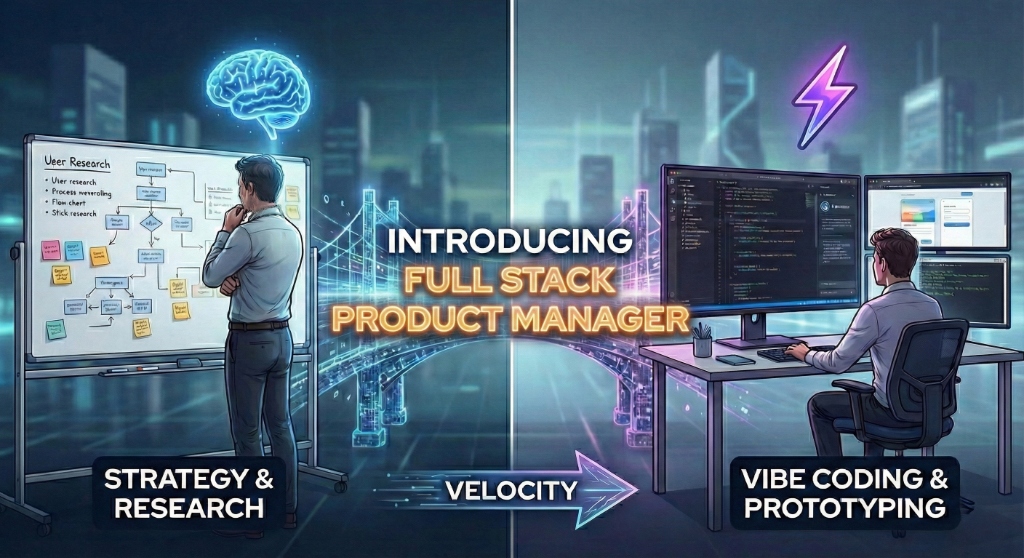
For a decade, the "Full Stack" label belonged exclusively to engineering. But as the barriers to building software collapse, that definition is migrating. We are entering the era of the Full Stack Product Manager (FSPM) - a professional who doesn't just manage a roadmap, but possesses the "vibe coding" skills to take a feature from a customer interview to a live, functional prototype in a single afternoon.
Previously, a PM’s primary output was documentation: PRDs, Jira tickets, and slide decks. The FSPM changes the nature of the output. Their "stack" now includes:
- Deep customer research and outcome-based prioritization.
- UI/UX design and high-fidelity wireframing.
- Vibe coding (using AI-driven IDEs like Cursor or Bolt) to build functional prototypes.
- Deployment of non-production environments to test features with real users in the wild.
For an FSPM, vibe coding is a superpower. Instead of asking a designer for a mockup or an engineer for a POC (Proof of Concept), the FSPM just builds it.
This eliminates the "translation tax" — the inevitable loss of intent that happens when a PM tries to explain a vision to a dev team through text alone. When the FSPM hands over a feature to the production team, they aren't handing over a document; they are handing over a working, "vibed-out" reality.
Does This Actually Make Sense?
Yes, but with one major caveat.
The reason this works right now is velocity. AI has turned the "How" (coding) into a commodity, which makes the "What" and the "Why" (Product Management) more valuable than ever.
With this shift:
- Hypotheses are tested in hours, not weeks. You validate the value before a single line of production code is written.
- Technical respect is earned. Engineers love a PM who understands the constraints of a database or an API because they’ve actually touched the code.
- No more "half-baked" features. Technical trade-offs are understood upfront, not discovered during a sprint demo.
MOST IMPORTANT
An FSPM must remember that vibe-coded prototypes are for validation, not for scale. The goal isn't to replace the engineering team; it’s to provide them with a blueprint so well-validated that the "final" build is virtually guaranteed to succeed.
This is the next phase of the Product Generalist. In a world where AI can handle the syntax, the PM who can't "build" will soon be as obsolete as a designer who can't use a computer.
Thanks for reading.
More Articles
Google is Disrupting the Final Frontier of Content: Project Genie
The Death of the Dashboard: Why Moltbot is the Last "Tool" You'll Ever Need
Stop Piloting AI. Start Using It Like It Matters.