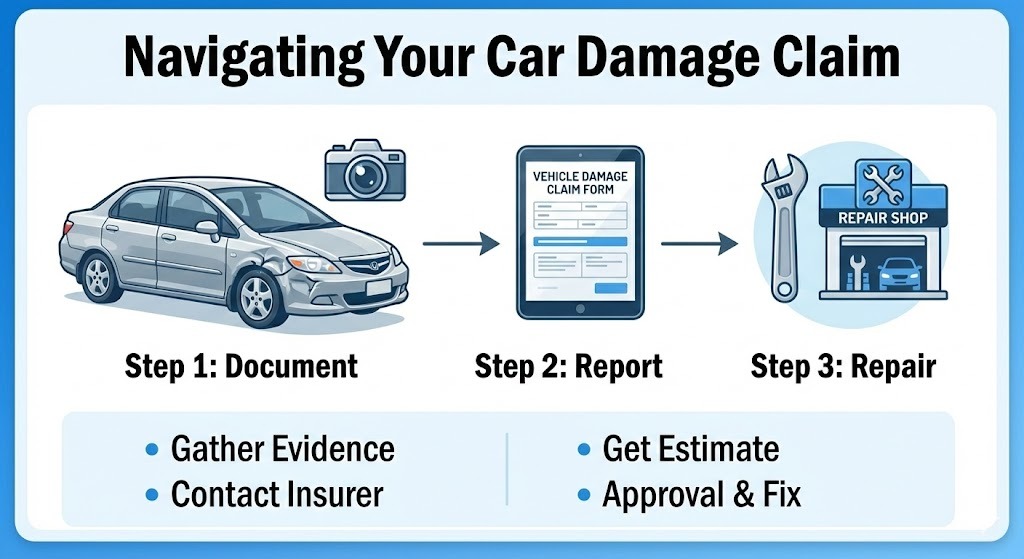
Using GenAI to Detect False Auto Claims Through Incident Reconstruction
Overview
Auto insurance claim volumes are rising rapidly as vehicle ownership grows. Alongside genuine claims, insurers are also seeing an increase in inflated, inconsistent, or fraudulent claims, leading to unnecessary payouts and operational strain.
To address this challenge, we explored how Generative AI (GenAI) can strengthen the claim validation process by converting a customer’s incident narration into a visual + logical reconstruction of the accident—helping distinguish real events from false or exaggerated ones.
The Problem
Traditional claim validation depends heavily on:
- Customer-written incident descriptions
- Manual adjuster assessment and experience
- Photos submitted after the incident (often incomplete, unclear, or misleading)
Challenges with the Current Process
This creates predictable issues at scale:
- Verification Gaps: Difficulty validating if the incident happened as narrated.
- Delays: Repeated clarification and investigation loops slow down approvals.
- Leakage Risk: Increased risk of paying out false or inflated claims.
- Operational Strain: Higher claim settlement cost, cycle time, and manual workload.
The result is a workflow that is reactive, human-heavy, and inconsistent under high volume pressure.
The Opportunity: Claims Narration as a High-Value Signal
In most claim journeys, customers are expected to narrate the incident clearly—what happened, where, what objects/vehicles were involved, and how the damage took place. This narration is one of the earliest and richest sources of context, yet historically underutilized due to its unstructured nature.
GenAI changes that. With the right workflow, incident narration becomes a powerful input to:
- Understand incident context deeply.
- Identify hidden inconsistencies in the story.
- Visualize the event to validate damage plausibility.
- Create an early-stage “confidence layer” before payout decisions.
The Solution: GenAI-Powered Incident Reconstruction
We designed a GenAI-assisted workflow that converts a customer’s narration into an incident reconstruction model and evaluates whether reported damages align with what likely occurred.
How It Works (End-to-End Flow)
- Narration: Customer narrates the incident (typed text or voice input).
- Extraction: GenAI extracts structured accident attributes (Speed, Direction, Angle of impact, Road conditions, Objects involved).
- Reconstruction: The system generates an incident mockup/reconstruction (scenario-based or visual).
- Validation: Expected damage patterns are mapped and compared against claim photos, stated damaged parts, and known vehicle impact patterns.
- Decision Support: Claims are classified into buckets:
- ✅ Likely genuine
- ⚠️ Needs manual review
- 🚩 Likely inconsistent / suspicious
Key Capabilities
-
Incident Mockup Generation Transforms narration into a reconstructed scenario that represents how the accident likely occurred, helping adjusters validate story logic faster.
-
Damage Plausibility Checks Evaluates whether the damage reported (and visually shown) aligns with the described collision type, direction, and severity.
-
Fraud Signal Identification Flags common inconsistency patterns such as narration vs. photo mismatches, illogical damage points, or severity mismatches.
-
Smart Escalation Only suspicious cases are routed to investigators, reducing unnecessary effort across the claims ops team.
Impact & Business Value
This approach improved both claim accuracy and cost efficiency by introducing a structured “truth check” early in the process.
Operational & Business Outcomes
- Fewer False Payouts: Reduced fraudulent or inflated claims approved unintentionally.
- Faster Settlements: Genuine claims are processed faster (Higher STP).
- Efficiency: Reduced investigator workload and adjuster fatigue.
- Direct Savings: Every prevented false payout adds directly to the bottom line (Loss Ratio improvement).
Success Metrics (KPIs)
To validate real-world impact, we tracked performance across multiple dimensions:
| Metric Category | Key KPI | Target Improvement |
|---|---|---|
| Fraud Detection | Suspicious Claim ID Rate | 5%–20% |
| False Positive Reduction | 15%–35% | |
| Claim Consistency Score | +20% Accuracy | |
| Operational Efficiency | STP (Straight Through Processing) | +10%–30% |
| Investigation Volume Reduction | 20%–45% | |
| Avg. Handling Time (AHT) | 15%–40% Reduction | |
| Financial Impact | Fraud Leakage Reduction | 10%–30% |
| Loss Ratio Improvement | 0.5–2.5 pts |
Sample Results Dashboard
- +25% improvement in claim decision confidence
- -35% reduction in investigation escalations
- -30% faster average claim closure time
- +15% increase in Straight Through Processing (STP)
Measurement Methodology
- Baseline Benchmarking: We established "truth anchors" using historical data (cycle times, fraud hit-rates, leakage estimates).
- Ground Truth Labeling: Used dual-review sampling of past claims to create labeled datasets (Genuine vs. Inconsistent vs. Fraud) for model evaluation.
- Controlled Rollout (A/B Testing):
- Phase 1 (Shadow Mode): Backend scoring only, no decision impact.
- Phase 2 (Assisted Mode): Recommendations shown to adjusters ("Human-in-the-loop").
- Phase 3 (Decisioning Mode): Auto-clear for low-risk, auto-escalate for high-risk.
Conclusion
Fraud detection in auto insurance has historically been reactive and manual. GenAI enables a shift toward proactive claim intelligence, where customer narration is converted into a structured incident reconstruction to validate damage plausibility.
This serves as a real-world GenAI use case with clear business value: better decisions, faster settlements, and measurable savings.
Thanks for reading.