Digitizing SOP Compliance in Fashion Retail
Overview
Large fashion retailers depend on strict store-level SOPs (visual merchandising layouts, cleanliness, signage, etc.) to deliver a consistent brand experience. Traditionally, regional managers travel to stores or collect paperwork to verify compliance, leading to delays, blind spots, and lost sales.
In fact, one industry survey found 70% of unhappy customers cited dirty floors or messy shelves as the reason they had a bad experience. With dozens or hundreds of stores to manage, ensuring every location sets up displays correctly and is ready on time is very challenging.
This case study shows how a mobile SOP app (with image evidence and dashboards) transformed store execution, dramatically improving task completion and store standards.
The Challenge: Manual Compliance is Slow and Error-Prone
Scale & Timing
A major fashion chain with hundreds of outlets needed every store to reset displays and clean thoroughly before opening. If a window display or restroom isn’t ready by opening, it can’t be fixed on the fly while customers shop. Meeting fast, timed SOPs (like a morning VM reset or nightly cleanup) across all locations exceeded the capacity of paper checklists or ad hoc inspections.
Siloed Visibility
Head-office staff had little real-time visibility. Reports trickled in days later via spreadsheets or phone calls. As one source notes, relying on manual audits and delayed reporting often “leads to reactive measures, resulting in lost sales and strained retailer relationships.”
Inconsistent Execution
Without a systematic tracking tool, display standards and hygiene could drift. For example, study after study shows customers quickly notice a dirty store – one found 91% of shoppers form a negative view of a retailer if it’s not clean. Inconsistent visual merchandising likewise erodes brand image.
With these pain points – wasted time, rising errors, and uneven store conditions – corporate realized an automated solution was needed.
The Solution: Mobile App with Real-Time Checklists and Image Verification
We developed a smartphone/tablet app that digitizes every SOP checklist and ties each task to live status updates and photos.
Key Features
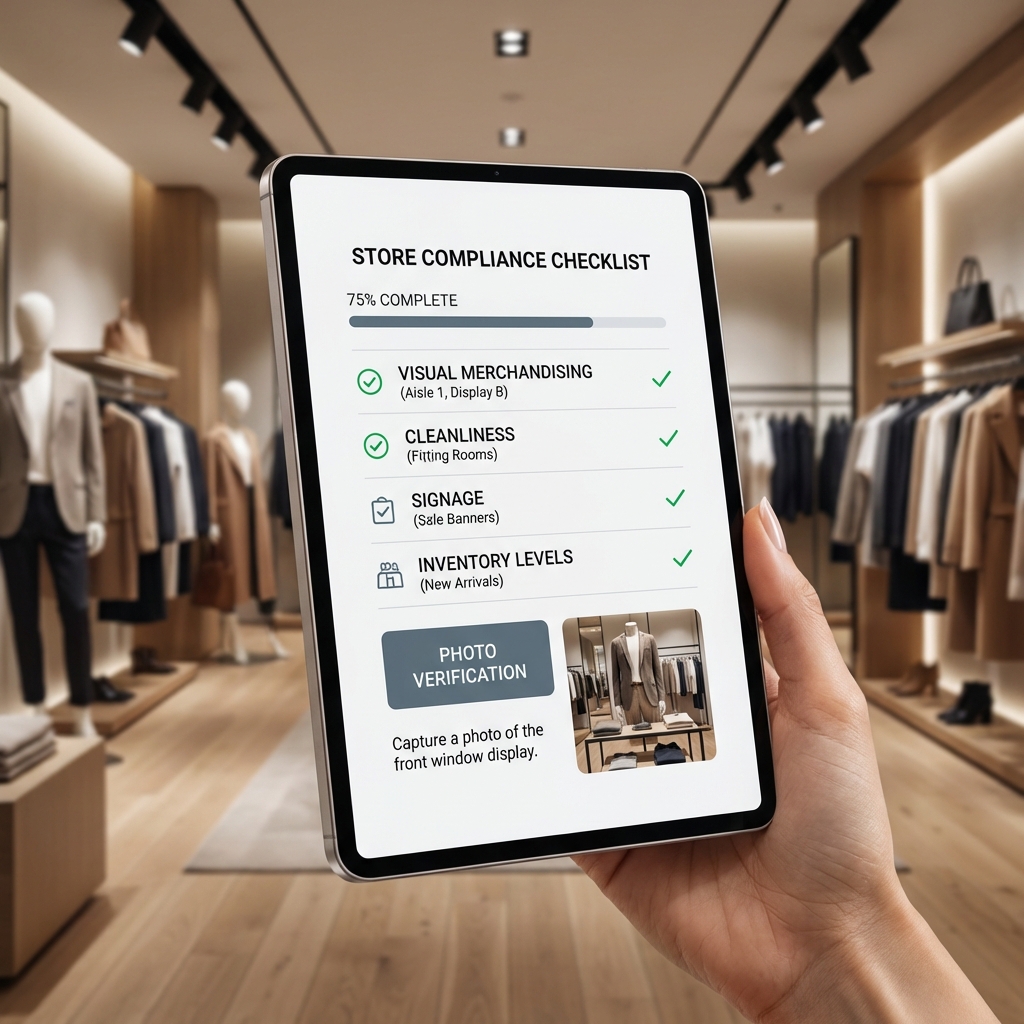
- Guided Mobile Checklists: Each store associate sees daily and campaign-specific tasks on their device (e.g., window dressing, shelf arrangement, cleaning floors, restocking mannequins). Step-by-step instructions and due dates ensure critical tasks happen on time. Associates simply check off items as they complete them.
- Photo-Based Proof: Associates snap a photo for each completed task (for example, the finished display, or cleaned section). The app immediately records the image as proof. Modern image-recognition tools can then “instantly confirm compliance” against the planogram or SOP.
- Geotag & Timestamp: Each submission is geo-tagged and timestamped, so HQ knows the photo came from the right store and at the correct time. This prevents backdating and ensures accountability.
- Automated Alerts & Queries: If an image shows a problem (missing signage, poor hygiene, etc.), the system auto-alerts managers. For instance, an alert might say “Fix window display – mannequins missing”, prompting immediate correction.
- HQ Dashboard & Reporting: All data flows into a central dashboard. HQ and regional directors see real-time store completion rates and compliance percentages for each SOP. They can drill down by store or district, filter by campaign, and see which locations are behind.
A store associate uses the mobile app to check off tasks and upload a photo of completed VM or hygiene work. The image is instantly analyzed against the plan, giving HQ real-time confirmation of compliance.
Implementation & Workflow
App Rollout & Training
We launched the app in phases, training store teams on new checklists (daily and ad-hoc). Training emphasized timely photo submissions (e.g., “Take a close-up of Side 1; Side 2” of a display). Managers and associates learned to use the tablet or phone at shift start and end.
Campaign Updates
Whenever a new marketing campaign or merchandise reset occurred, checklists and planogram images were updated centrally. Stores received push-notifications when new tasks or image templates were available, so no store lagged on the new SOP.
Live Monitoring
As photos and data came in, the HQ team monitored compliance. If a store lagged on a mandatory task (e.g., “Open Store”, “Floor Cleaned”), reminders could be sent automatically. Timestamping allowed regional managers to quickly spot chronic issues.
Agentic AI Analysis (Next Step)
Even in this first implementation, we applied AI to images. Looking forward, we will introduce advanced agentic AI that not only checks images but learns which stores often deviate and proactively nudges managers. Such agentic systems can, in theory, automate or assist up to 60% of today’s manual compliance tasks.
Results: Metrics and Impact
The digital SOP app yielded dramatic gains:
- Faster Execution: Manual errors dropped by 87% and tasks were completed 38% faster. Stores no longer spent hours filling reports – completion is logged via the app instantly. HQ saw a ~60% reduction in audit time.
- Higher Compliance: Compliance climbed into the mid-90s% (from 70–80%). By marking tasks incomplete until done, the system enforced consistency.
- Time Savings: Field managers cut their admin time by about 33%, spending less time chasing updates and more time supporting staff.
- Actionable Insights: The centralized dashboard turned raw data into clear insights. HQ teams could sort stores by key issues (e.g., inventory gaps, display errors).
- Better Brand Experience: Witnessing consistent displays and spotless floors boosted customer perception and loyalty scores.
Future Evolution: Agentic AI and Beyond
This case is just the first step. The next generation of our solution will incorporate agentic AI – autonomous agents that learn and improve compliance over time. According to industry analysts, agentic AI can turn static processes into continuous learning systems, automating routine decisions and surfacing insights.
In practice, an agent could continuously scan new store images and instantly recommend corrective actions, or even trigger replenishment if sales trends diverge. McKinsey predicts that with agentic systems, up to “60 percent of once-manual tasks” could become automated.
By combining mobility, computer vision, and AI, modern retail operations can finally achieve the omnichannel promise: stores become extensions of HQ’s brain. The result is happier customers and stronger sales – all stemming from a smarter, automated SOP system.
Thanks for reading.