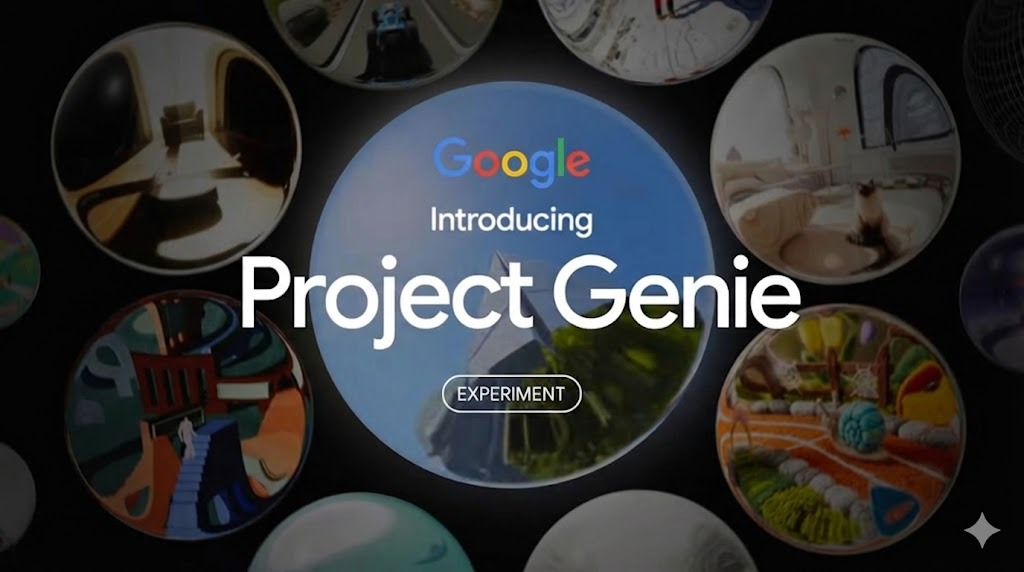
Google is Disrupting the Final Frontier of Content: Project Genie
Google is no longer just organizing the world’s information, it’s building the world itself.
With the official launch of Project Genie (early stages), we are witnessing a paradigm shift. We’ve moved from text to images, and from images to video. Now, Google is disrupting the most advanced content form there is - Interactive Worlds.
What exactly is Project Genie?
Imagine a world you can manifest simply by describing it. Eg. create me a first-person view of yourself roaming the craters of the Moon. In seconds, you’re there.
But this isn’t a pre-rendered video. This is a generative world model (Genie 3).
- Real Terrains & Physics: It generates the path ahead in real-time. It hasn’t been “coded” with the laws of gravity; it has learned them by watching millions of hours of video.
- Total Interaction: You aren’t just a spectator; you are a player in a world that responds to your actions.
The “Photo-to-World” Leap
You can take a single photo of a toy or a sketch of a city and “step inside” it instantly.
The AGI Connection
This isn’t just a toy; it’s a leap toward Artificial General Intelligence (AGI). For an AI to truly understand our world, it needs to understand space, persistence, and causality.
Project Genie proves that AI can now “dream” a logical, physical reality. This is the internal imagination that robots will use to navigate our homes and streets.
The 3D Artist: From “Asset Builder” to “World Architect”
Let’s address the elephant in the room: What happens to the 3D artist?
For decades, artists spent months on meshes, textures, and boxes. Project Genie suggests a future where the manual labour of 3D modeling is abstracted away.
- The Shift: Artists move away from manual polygon manipulation toward high-level curation.
- The New Role: Instead of building a single chair, the artist of 2026 defines the “aesthetic DNA” of an entire universe. The AI handles the rendering; the human handles the vision, logic, and soul.
Impact Across Industries
While still in early development stages, the downstream impact could be significant across industries:
Digital Content & Entertainment
Long production cycles for environments and assets could shrink dramatically. Smaller teams and independent creators may be able to build high-quality, large-scale digital experiences in a fraction of the traditional time.
Marketing & Customer Experience
Brand experiences could shift from passive viewing to interactive participation, where users explore, customize, or experience products inside dynamically generated virtual environments.
Physical & Industrial Sectors
Advanced simulation environments could enable testing, training, and validation of real-world systems in highly realistic digital scenarios, helping teams evaluate performance, safety, and design outcomes before physical deployment.
Whether you are in retail, real estate, or tech, the ability to create instanced reality means your customers can now test-drive your products in a digital twin of their own specific environment.
The barrier between “seeing” and “experiencing” has officially vanished.
Thanks for reading.
More Articles
The Death of the Dashboard: Why Moltbot is the Last "Tool" You'll Ever Need
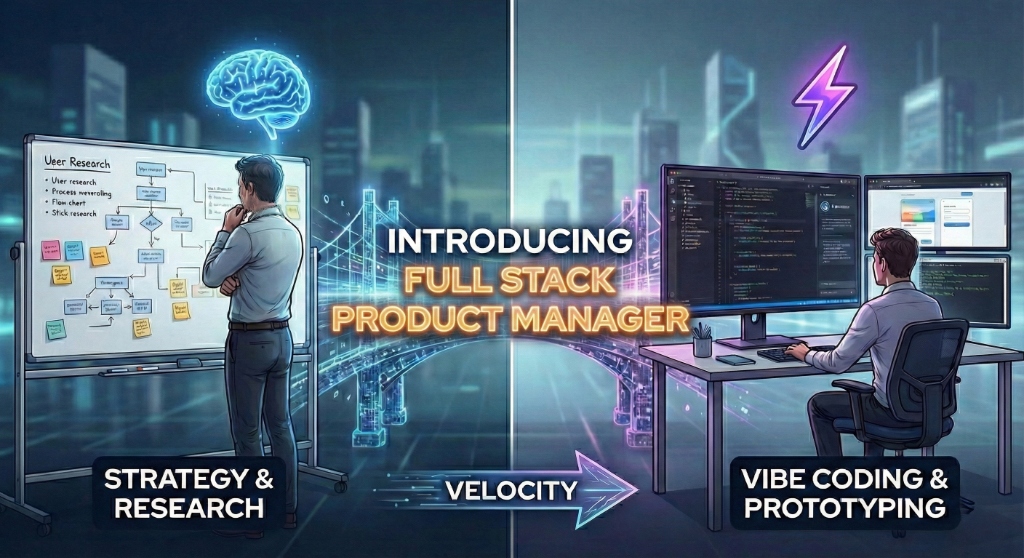
The Rise of the Full Stack Product Manager (FSPM)
Stop Piloting AI. Start Using It Like It Matters.